
How to make friends online, without dating apps
You can make friends online without a dating app by joining a place built around something you already do, then showing up there repeatedly. This guide covers the kinds of places, what each is good for and what to watch out for.
Join a community around an interest, such as a game, a hobby or a project you are building. Take part in the same place every week and talk to a few people directly. Online friendships form the same way offline ones do: repeated contact over time.
Most advice about meeting people online assumes you want a date. If you just want friends, the better route is a place where people gather around a shared interest, with no profile-swiping involved. The people there already have something to say to you, and you have something to say to them.
How online friendship works
It follows the same pattern as any friendship: you see the same people repeatedly, you talk about more than the task at hand, and one of you makes the first move. A University of Kansas study by Jeffrey Hall estimated roughly 50 hours together to go from acquaintance to casual friend. The KU summary counts hanging out, joking around and playing video games as the kind of time that helps. We go through it in how to make friends as an adult.
The same rules apply online, with one extra problem: it is easy to lurk. You read a server for months and never say anything. So the practical advice is to pick one or two places and speak up, even briefly.
It is also fair to say that close online friendships are not the norm. In the 2021 Survey Center on American Life report, 39% of Americans had online-only friendships, but only 8% said they had made a close friend online. Plan for slow, gradual progress.
Kinds of places, and what each is good for
Interest communities on forums and subreddits
Good for: finding people who care about something narrow, like a specific game, hobby or programming language. Threads are public, so you can see how people talk before you join in.
The catch: posts and comments are slow and spread across time. It is easy to have a good exchange and never speak to the person again. To turn a thread into a friendship, move to direct messages after a few exchanges, if the person is open to it.
Discord servers
Discord is a platform for text, voice and video chat. It is organized into servers, which are communities, and channels, which are rooms for topics. Many servers are small and invite-only, and some are large public communities built around games or hobbies.
Good for: live conversation and regular faces. Small servers around a creative hobby or a game often have a handful of people who talk daily.
The catch: big servers are noisy, and channels move quickly. Look for one with a few dozen active members and a channel for casual chat.
Multiplayer game communities
Good for: shared activity. Playing together gives you something to do and talk about, which suits people who dislike open-ended chat. This fits Hall's finding that playing games together counts as time that builds friendship.
The catch: friendships can stay inside the game. If you like someone, suggest talking outside the match.
Open-source projects and maker communities
Good for: people who build things. A project with a chat channel or a regular call has a built-in reason to talk. You can learn something and meet people at the same time.
The catch: the talk can stay about work. Hall's findings suggest time spent working together counts for less than time spent on leisure, so make space to talk about other things.
Friend-finding apps
Some apps, such as Bumble's BFF, are made for platonic friendships instead of dating. They match you by interests and let you start a conversation. They suit people who prefer a one-to-one start. The catch is the same as with any matching service: you still have to move from a first chat to regular contact.
Virtual worlds
Good for: a place that feels like a place. You walk around, sit near people and talk, which can feel less formal than a chat server. Researchers Constance Steinkuehler and Dmitri Williams argued in 2006 that some online games work like cafes or pubs where people meet casually. The University of Illinois news release reports their conclusion that such worlds work better for bridging, which means meeting people unlike yourself, than for forming deep bonds. We write about this in the third place, and can it be online.
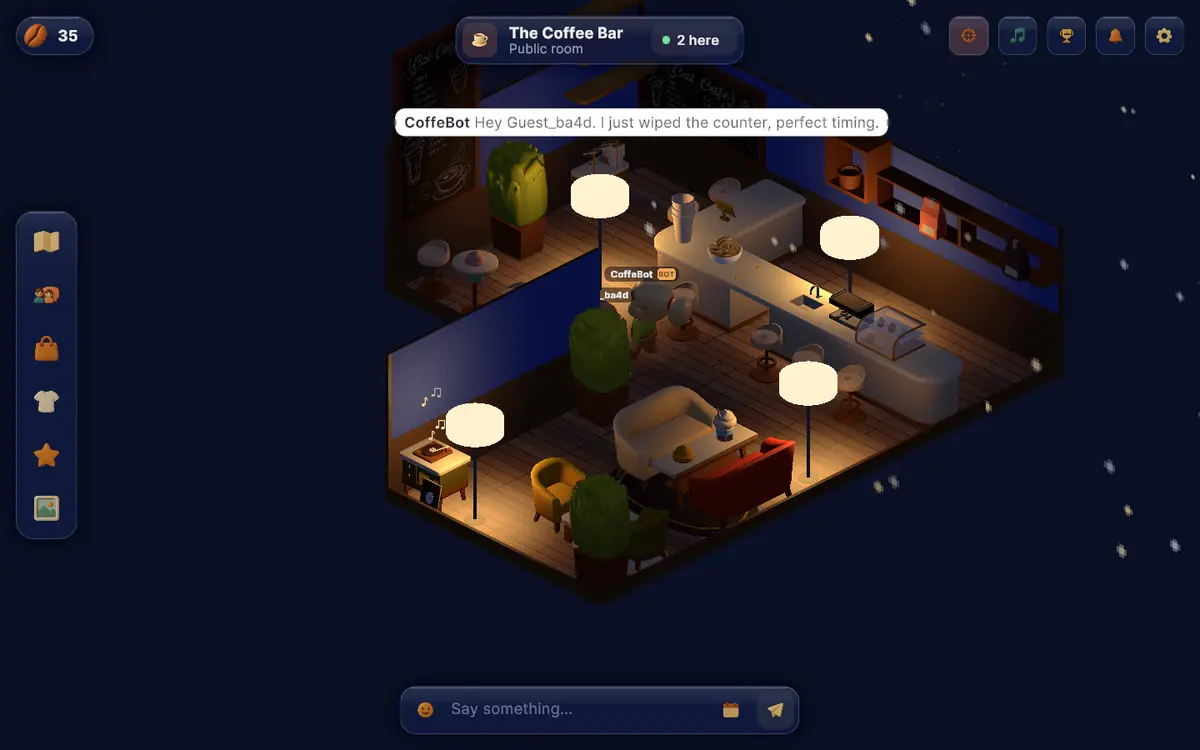
The catch: most virtual worlds are small, so you may find a quiet room. That is true of Midnight Cafe, a free browser cafe that launched recently and is run by one person. It has public rooms where you can sit and talk in speech bubbles, text only, with no voice or video. It is worth a visit if you like a calm place, but do not expect crowds.
How to start talking to people
- Pick one community and read for a day to learn how people talk.
- Introduce yourself with a sentence about what you are working on or playing.
- Reply to other people more than you post. Comment on what they shared.
- Come back at the same time each week. Regulars notice each other.
- After a few good exchanges, suggest something small: a game, a call, or just continuing the chat in direct messages.
Do not try to join five places at once. The aim is to be a familiar face somewhere.
What to write in a first message
Many people stall here. A first message does not need to be clever. It needs to be specific and easy to answer.
- Weak: "Hi" or "Anyone here?" It gives the other person nothing to respond to.
- Better: "I just started learning the same engine you posted about. How long did the movement code take you?"
- Also fine: "I am here most evenings and working on a small puzzle game. What are you building?"
Ask about something the person has already shared. Then give a short answer to the same question about yourself, so the exchange goes both ways. If they do not reply, do not take it personally. People miss messages, and a quiet reply from one person says little about the next.
It also helps to pick a regular slot. If you are in a community at 9 p.m. on Tuesdays and Thursdays, people start to expect you. After a few weeks, a joke or a question that refers to the last time you talked is easy to make, and that is usually the point where a contact turns into a friend.
Staying safe
A few basic habits cover most of the risk.
- Do not share your address, workplace, school or phone number early. Let trust build first.
- Be careful with anyone who asks for money, gift cards or favors. The FTC's guidance on romance scams says not to send money or gifts to someone you have not met in person. The same applies to friends you have only met online.
- Be wary of someone who gives you intense attention fast and then asks for something. The FTC lists that pattern as a red flag.
- If you ever meet in person, choose a public place, tell someone where you are going and arrange your own way home.
- You can leave or block at any time. You do not owe anyone a reply.
When it is not working
After a month of regular visits, ask whether you are talking to anyone. If not, change the place. Some servers have cliques, some subreddits do not reply, and some rooms are empty at your hours. That says little about you. Try a smaller community or a different time of day, and keep what you learned.