
The third place, and can it be online?
A third place is somewhere that is neither home nor work where people gather informally and come back often, like a cafe or pub. The idea comes from Ray Oldenburg. This guide explains it and asks if an online space can be one.
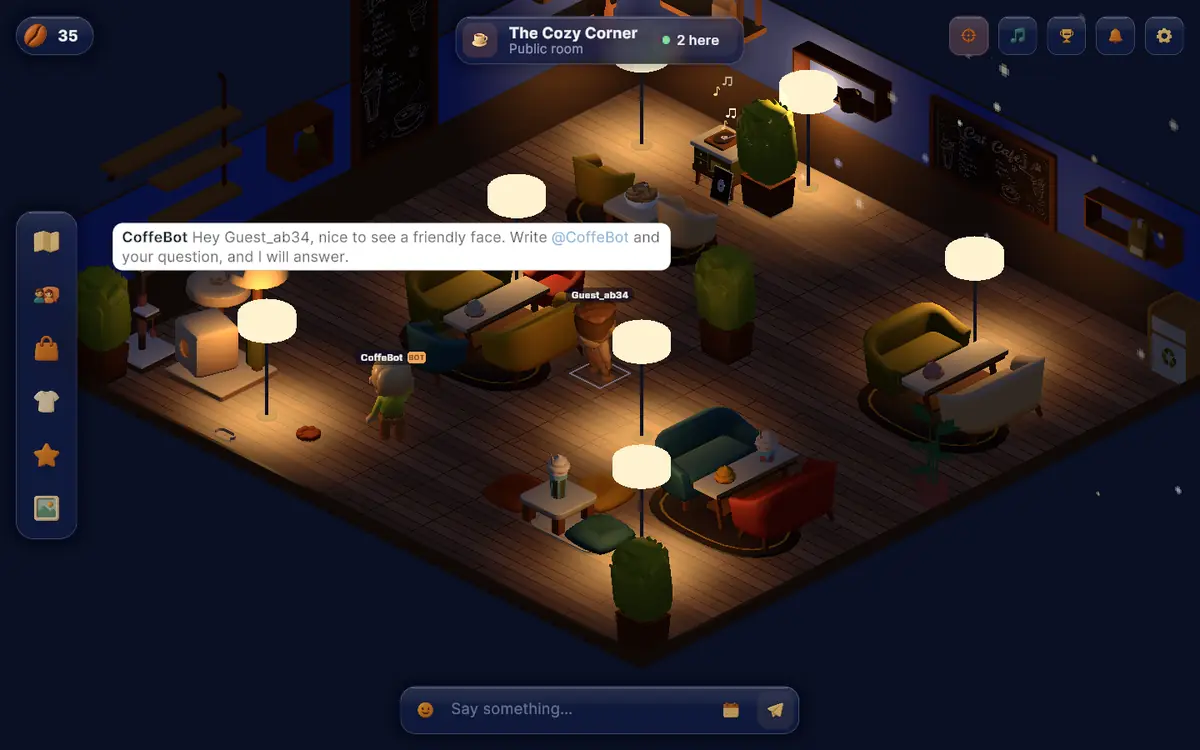
A third place, a term from Ray Oldenburg's 1989 book The Great Good Place, is an informal public place away from home and work where regulars gather to talk. Some researchers argue online games and virtual worlds can work as third places, with limits.
"Third place" is a phrase that turns up in coffee chain marketing, urban planning and articles about loneliness. It has a specific origin and a specific meaning, and knowing them helps you judge whether a given cafe, club or website qualifies.
Where the term comes from
Ray Oldenburg introduced the term in his 1989 book The Great Good Place. His scheme is simple. Home is the first place. Work is the second. The third place is where people gather informally and regularly, outside both. The Wikipedia article on the third place describes the idea and its history.
The point of the idea is that a community needs somewhere other than home and work to form. Without it, people have family and colleagues but nowhere to meet neighbors or people they did not choose.
What makes a place a third place
The Wikipedia article, drawing on the 2023 edition of the book (co-authored with Karen Christensen), lists seven traits. Other summaries group them differently, but they cover the same ground. A third place is:
- Open and inviting. You do not need an invitation or an appointment.
- Comfortable and informal. You feel you belong there.
- Convenient. It is close enough to visit often.
- Unpretentious. Everyone is on equal footing, and it is not expensive.
- Home to regulars. There is often a host who greets people.
- Centered on conversation. Talk is the main activity.
- Often lighthearted. Banter and laughter are common.
Two traits do most of the work: regulars and conversation. A venue can be well designed and still not be a third place if people come once, wear headphones and leave.
Why people say third places are disappearing
The Wikipedia article reports several concerns. Third places are unevenly distributed, and areas with higher poverty and rural areas often have fewer. It also notes the view that closing neighborhood third places may reduce social support and a sense of belonging. Oldenburg himself considered chain establishments less hardy than locally owned ones, because the money goes to distant owners.
These are claims that people debate, and the article does not offer a count of how many third places there are now compared with 1989. Treat "disappearing" as a concern raised by researchers and writers, not a measured fact. Separately, surveys show people have fewer close friends than in 1990. The 2021 Survey Center on American Life report found 12% of Americans with no close friends, compared with 3% in 1990. That is about friendships, not places, but it is the same worry.
Coffee shops and the laptop question
Coffee shops are the standard example. Coffeehouses have a long history as gathering places, going back to the "penny universities" of 17th-century England, as the Wikipedia article notes. Today many people work in them, which raises a question: is a cafe full of people on laptops still a third place?
The same article notes two sides. Public Wi-Fi lets remote workers use cafes, libraries and coworking spaces as third places and can ease the isolation of a home office. But it also reports a concern that internet access can create a "hollow effect," where people are physically present but do not make social contact. One cafe the article describes, Nomad Cafe in Oakland, responds with live jazz and patron surveys to encourage interaction.
A fair rule: a place is a third place when the regulars know one another, not when they happen to sit in the same room. If you work in a cafe for years and never speak to anyone, it is a quiet second place. If you work there and chat with the same barista and two other regulars, it is closer to what Oldenburg described.
Can an online space be a third place?
The argument for
In 2006, the researchers Constance Steinkuehler and Dmitri Williams published a paper in the Journal of Computer-Mediated Communication called "Where Everybody Knows Your (Screen) Name: Online Games as 'Third Places.'" The University of Illinois news release describes the work. Williams played Asheron's Call and interviewed 30 players. Steinkuehler ran a two-year ethnography of the Lineage games, with repeated interviews of 16 key informants. They argued that these games can work like virtual coffee shops or pubs, where informal social interaction happens.
The Wikipedia article adds that, in their view, avatars reduce visible social markers and regulars enforce norms. Those match Oldenburg's traits of equal footing and regulars.
The argument against, and the limits
The same authors were careful. According to the release, they found that virtual worlds "appear to function best as bridging mechanisms, rather than as bonding ones." In other words, they connect you to people unlike you, but usually not through deep emotional ties. They also warned that heavy play might displace offline relationships for people who need strong ones, and Williams said the result depends on a person's overall balance.
Other limits are easy to see. Online places lack the physical setting, such as smell, noise and a barista who knows your order. They can also be hard to find, and they depend on one company staying in business. And "convenient" and "accessible" mean different things when the place is a browser tab.
The studied games were fantasy MMOs from the early 2000s. Whether the finding holds for a small cafe-style chat world is untested as far as we know, so treat it as an argument by analogy.
Third place, or just a place to sit?
The term gets used loosely, so it helps to separate three things people call a third place.
- A venue. A cafe, library or park bench. It has the right setting, but nothing happens unless people use it to meet.
- A habit. You go to the same place at the same time each week. This is the part you control.
- A group of regulars. People who recognize each other and talk. Oldenburg cared most about this part, and it is the slowest to appear.
A venue alone does not give you the other two. That is why a new cafe, or a new online room, can feel empty for a while even when the design is right. Regulars take weeks to build up, and they only build up if the first few visitors keep returning.
What to look for in an online third place
Use Oldenburg's list as a checklist.
- Can you walk in? Free, no application, no long sign-up.
- Do the same people come back? Visit at the same time for a week and see if you recognize anyone.
- Is talk the point? A place built around a competitive goal makes everything transactional.
- Is the mood light? If everyone is arguing or selling, move on.
- Is there a host or moderator? Someone has to keep it welcoming.
- Is it open at your hours? A late-night place helps people who work evenings.
Making a third place work for you
Whether the place is a cafe on your street or a website, the habit is the same: go often and at the same time. A third place needs regulars, and you become one by showing up.
- Choose a day and hour and keep them for a month.
- Say hello to the person you saw last time.
- Stay a little longer than you planned.
- Bring something to do, so being there is easy when you have nothing to say.
Our guide on how to make friends as an adult goes into how repeated time turns into friendship.